Kubernetes deployment risk scoring, explained
Deployment risk scoring answers one question before you ship: is this a safe moment to change this service? Here is what a pre-flight score actually weighs, how ChangeGuard AI’s CSC Score works, and where a score alone isn’t enough.
Runs read-only on your Kubernetes · advisory by default · it never prevents execution itself.
What deployment risk scoring is
A pre-flight readiness signal: it rolls up what’s true about your cluster right now — posture, recent change, live health — into a single, explainable score and a plain verdict, so a deploy decision isn’t a gut call.
Done well, a risk score is deterministic (the same inputs give the same score), explainable (you can see every factor behind it), and advisory (it informs the human, it doesn’t seize the wheel). A number you can’t interrogate isn’t worth trusting with a production decision.
What goes into the CSC Score
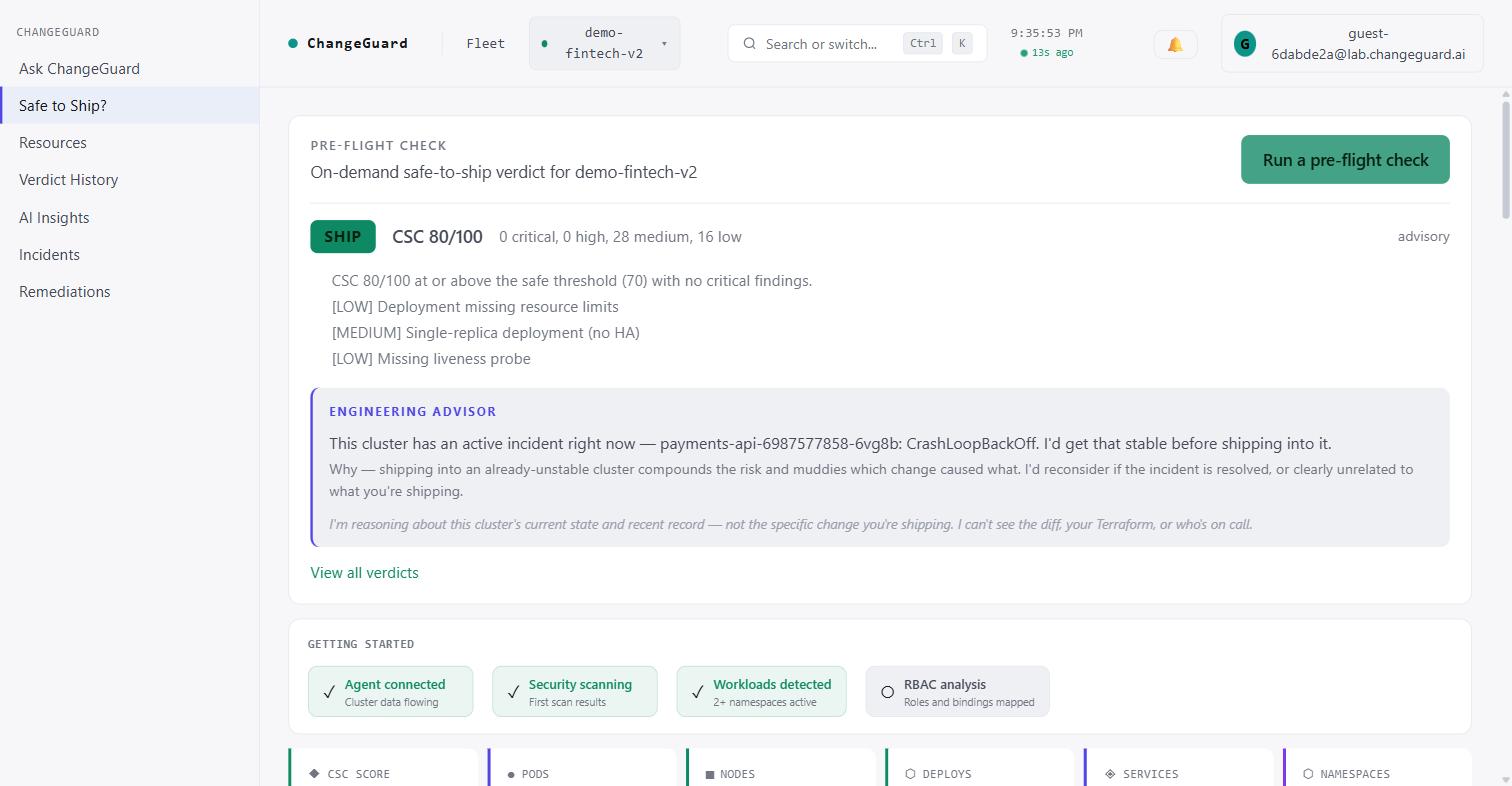
A deterministic 0–100 deploy-readiness score, and an on-demand SHIP / HOLD / BLOCK verdict with reasons. Every point traces back to a cited factor.
Security posture
CIS benchmarks (KubeBench), image CVEs (Grype), deprecated APIs (Pluto), and runtime signals — the standing risk in the cluster the change lands on.
Current cluster state
Live health and whether anything is already failing — a clean score means little if the target service is mid-incident right now.
Change context
What’s about to ship and how it relates to recent changes on the same workloads — the diff, not just the fact of a deploy.
The verdict is advisory. It gives you the reasons and leaves the call with you — in CI a BLOCK fails the check only where you enforce it.
Where a score isn’t enough — the Advisor
Someone asks “safe to ship?” The score says SHIP — but the cluster has an active incident on the very service being changed. Where the Engineering Advisor is enabled, it says so plainly: “this cluster has an active incident right now; I’d get that stable first.” The decision stays with the engineer; ChangeGuard AI just makes sure they’re not missing the one thing that matters.
- The deterministic score, and the read a senior engineer would add on top
- Led by what’s true right now — not generic best practice
- Advisory and challengeable: it tells you what would change its mind
The win: the judgment a senior engineer would add, at the moment of decision. See how the Advisor reasons →
Deployment risk scoring, answered
What is Kubernetes deployment risk scoring?
It’s a pre-flight signal that weighs your cluster’s current state — security posture, recent changes, active incidents — into a single, explainable readiness score and a SHIP / HOLD / BLOCK verdict, so you can judge a deploy before it ships.
How does ChangeGuard AI score a deployment?
The CSC Score is a deterministic, explainable 0–100 signal built from cluster posture (CIS benchmarks, image CVEs, deprecated APIs), current health, and change context. Every point traces back to a cited factor, so the score is never a black box.
Does a low score block my deploy?
No. Scoring is advisory by default — it gives you the verdict and the reasons; in CI a BLOCK fails the check only where you enforce it. You hold the decision.
What does the Engineering Advisor add to the score?
The score is deterministic; the Advisor adds what a score can’t know — like an active incident on the very service you’re changing — and says so plainly. It’s in Early Access.
See a deploy scored live
Watch ChangeGuard AI score a real change, return a SHIP / HOLD / BLOCK verdict with reasons, and add the Advisor’s read — in the interactive demo. No signup, no install.