The Engineering Advisor
The teammate that remembers every production change.
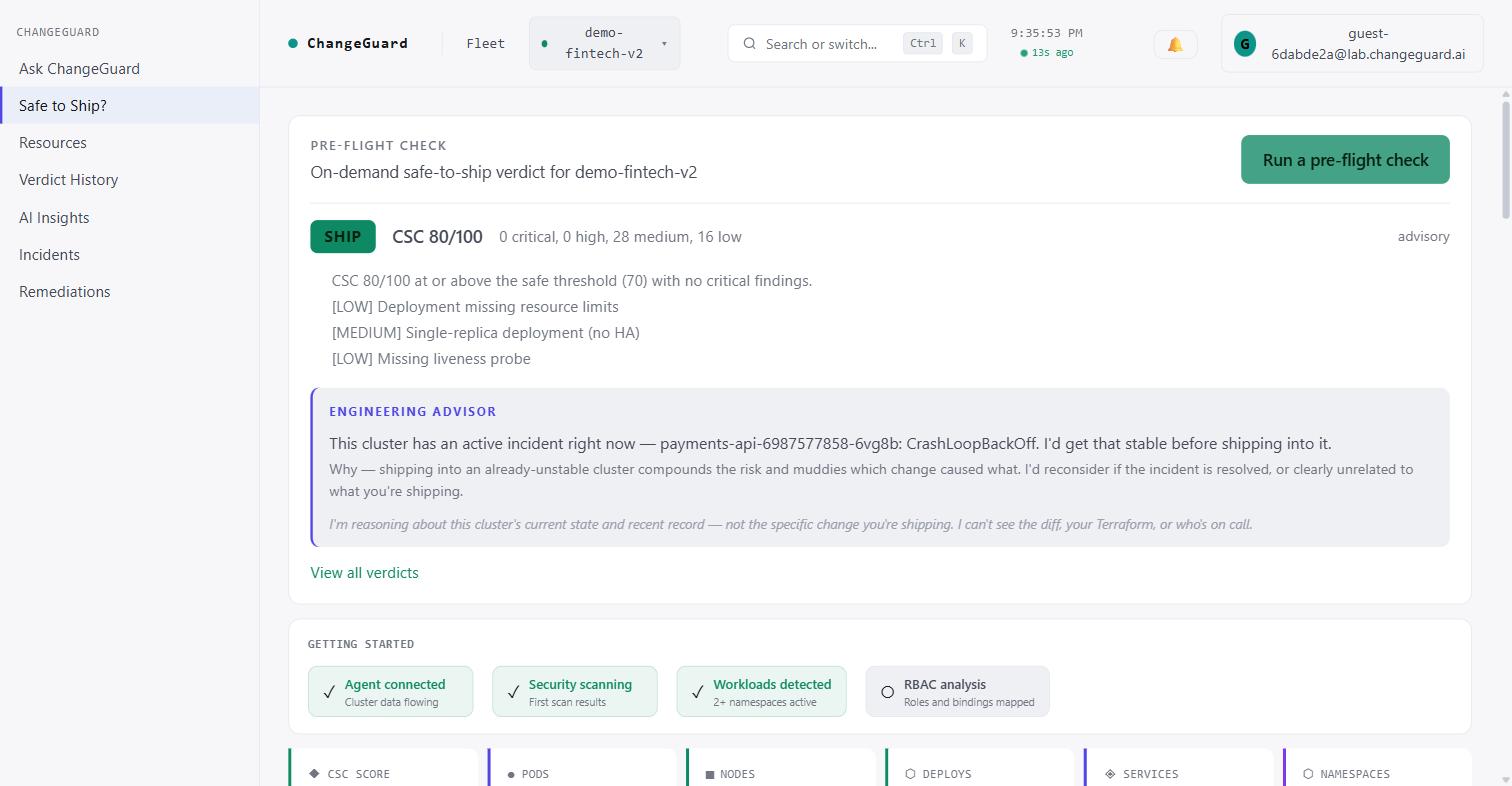
The read a senior engineer would give before a change proceeds — led by what’s true in production right now, honest about what it can’t see, and silent when it has nothing material to add. It informs your decision. It never prevents execution itself.
Early Access — running with design partners today, clearly labeled until generally available.
What it is
- A second set of senior eyes on every change — grounded in your cluster’s current state and your team’s history
- Advice that leads with what’s true right now, not generic best practice
- A participant in the decision that stays advisory — the call is always yours
What it isn’t
- Not a gate by itself — it states a verdict, and SHIP stays SHIP
- Not a chatbot — it doesn’t chat; it raises the one or two things that matter, or nothing
- Not a rules engine — the deterministic CSC Score already exists; the Advisor adds what a score can’t
When it speaks — and when it stays silent
Most advice tools optimize for looking smart. The Advisor optimizes for being worth listening to.
It speaks when
- Something is true right now that materially changes the risk — an active incident, a degraded dependency, an unusual failure pattern
- Your history says changes like this one have gone wrong before — with real counts, not vibes
- The mechanical verdict misses something a person who knew the system would catch
It stays silent when
- The change is routine and nothing in current state or history is material
- The evidence doesn’t support a concern — it will not manufacture one
- It would merely repeat what the score already told you
How it reasons
Current state first
It leads with what’s true in your cluster at this moment — the thing no static score or stale runbook can know.
Memory when material
It recalls similar changes and their outcomes — real incidents, real counts — only when they change the decision.
Reasoning shown
Honest ✓/⚠ factors and why-not-the-obvious-move. You see the reasoning, not just the conclusion.
Challengeable
It states what would change its mind — so you can check it, disagree with it, and act on your own judgment.
What it cannot see — and why that’s intentional
Trust is built by drawing the boundary honestly, not by pretending there isn’t one.
Outside its view today
- Your intent — why you’re making this change, and what you already ruled out
- Context outside the cluster and change history — Terraform plans, on-call schedules, business deadlines
- Conversations that never made it into the record
Why we built it that way
- It says what it can’t see, out loud, in the advice itself — so you weigh it correctly
- It reasons only from evidence it can cite — no guessing dressed up as insight
- Certainty it can’t back isn’t confidence; it’s noise. It would rather be limited and trusted
See the Advisor on your own changes
The Engineering Advisor is in Early Access with design partners. Everything generally available — change history and attribution, pre-flight verdicts, incident investigation, verified remediation — starts the moment the collector connects.