One judgment, before and after every production change.
A change is proposed. ChangeGuard AI judges it against the environment it will actually enter and answers SHIP, HOLD or BLOCK with the reasons in plain terms. If it ships, ChangeGuard AI observes what happened and writes that into the same record. If something goes wrong, it proposes the fix within the authority you grant. Nothing about this requires you to change how you deploy.
Proposed change → environment → judgment → outcome → history
Something is about to go to production
A pull request, a pipeline step, an agent, or a person in the product. ChangeGuard AI takes the description, the artifact, or the actual manifest.
The live state of where it will land
What is running there right now, what the environment can afford, how healthy it is. Read-only, refreshed continuously.
SHIP / HOLD / BLOCK, with reasons
Plain-terms reasons, plus an honest list of the evidence the judgment had and the evidence it did not have.
What actually happened
Your pipeline deploys as it always has. ChangeGuard AI records the result — deployed successfully, or an incident — against the change that caused it.
Fixed, verified, remembered
A fix is proposed; a person approves it, or your policy does. It is applied, verified, and kept in the permanent record with the judgment and the outcome.
What SHIP, HOLD and BLOCK mean
Three answers, each with its reasons. ChangeGuard AI is advisory by default: it states a position and does not prevent execution. In GitHub, a BLOCK fails the pull-request check and a HOLD never does; whether a failed check stops a merge is your branch rule, not ours.
SHIP
ChangeGuard AI sees no reason to hold this change. The evidence it had supports it, and the reasons say which evidence that was.
HOLD
Review first. Something is worth a look — often evidence ChangeGuard AI did not have, which it names. A proposed artifact that has not been independently evaluated is HOLD, never SHIP: missing evidence is never counted as safe.
BLOCK
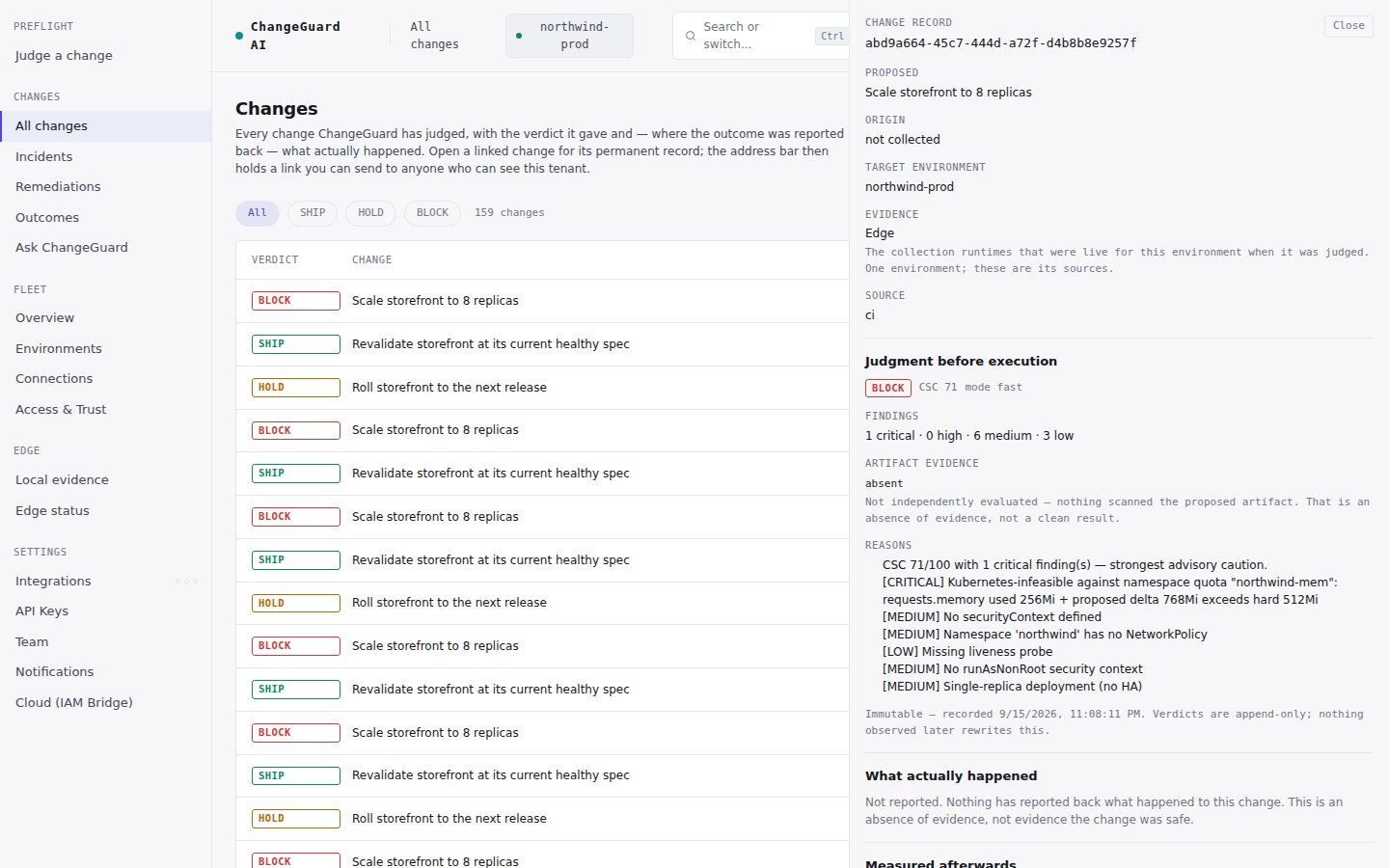
ChangeGuard AI advises against this change. Judged against live state it would fail or break something — exceed the environment’s memory budget, request more than its own limits allow, contradict what is actually running.
Where the judgment gets its facts
Every reason cites evidence. Every verdict lists what it had and what it did not have, so a judgment made on partial evidence says so.
The proposed change
The description, the artifact, or the actual manifest. From a pull request the workflow sends the changed manifests; by hand you describe the change and name the image.
The environment, live
Connected read-only, refreshed continuously: workloads, quotas, health, what is actually running. Connect centrally through your cloud account with nothing installed, or with a small read-only collector where evidence has to stay local. Either way the judgment is the same.
What happened before
Prior changes to the same target and their outcomes — recalled only when they change the decision, and shown when they do.
Collection details, permissions, and architecture: the documentation. Trust model and boundaries: Security & trust.
The loop closes on the same record
Observed outcome
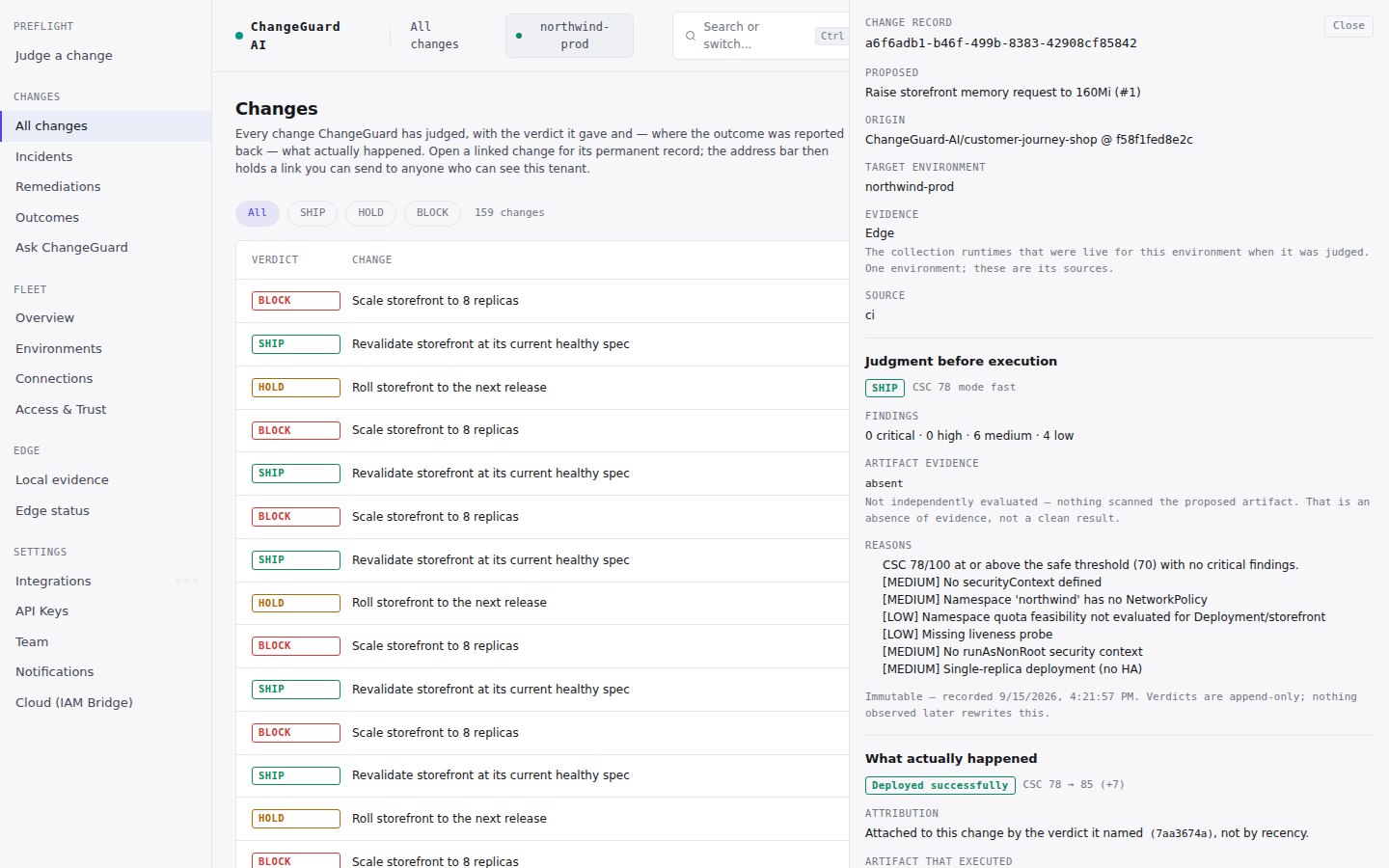
Deployed successfully, or an incident. Attached to the change by the verdict it named — never by whatever happened most recently. A change nothing reported on reads “not reported”, never “safe”.
Remediation, within your authority
Advise (the default): ChangeGuard AI proposes the fix and a person approves or rejects it. Auto (opt-in): it acts within a policy you write — namespaces, fix types, a confidence floor, an hourly cap. Per environment, never account-wide.
Verified before “fixed”
No fix is called successful until real health confirms it. Every fix keeps its approver on record. The watching side of ChangeGuard AI is read-only throughout; write access exists only where you grant it, scoped to the workloads you name.
What leaves your environment — and what never does
Never leaves
- Your source code
- The plaintext values of your secrets
- Execution authority — fixes run in your environment, scoped by the access you grant
Sent to ChangeGuard AI
- Environment state (workloads, events, posture)
- Change metadata and diffs from your pull requests and pipelines
- Findings you choose to ingest (vulnerability, benchmark, log signals)
Get your first verdict in five minutes
Start free and judge a change by hand — no environment required. Connect one when you want live context; connect GitHub when you want a verdict on every pull request.